
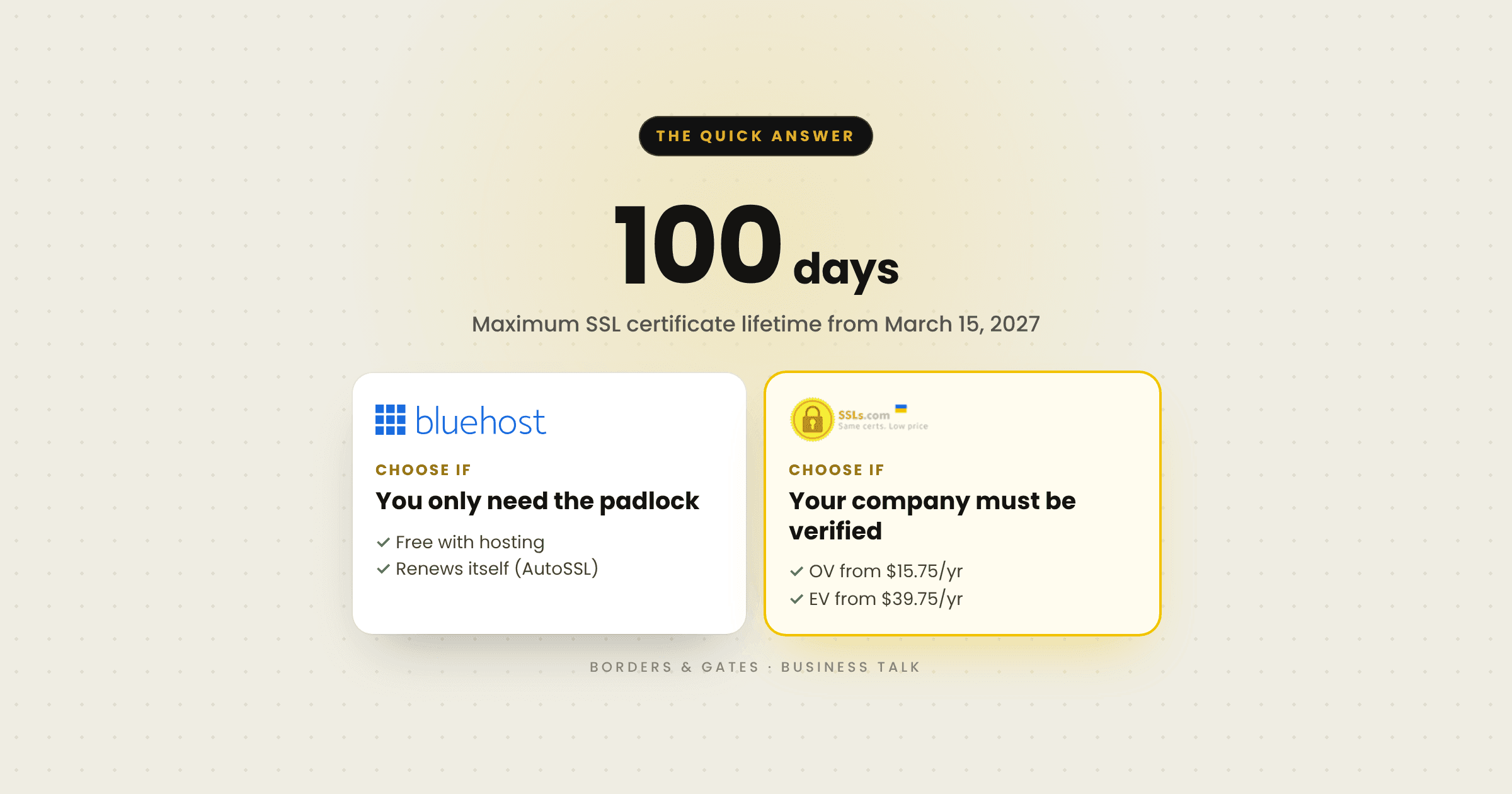
Choose Bluehost if your website only needs the padlock: its free SSL installs and renews itself, so the new 100-day SSL certificate rule costs you nothing extra. Choose SSLs.com if your business needs its verified company name on the certificate, with Organization or Extended Validation. From March 15, 2027, no public certificate can last longer than 100 days, falling to 47 days in 2029, so whichever you choose has to renew on time, several times a year.
“An SSL certificate is no longer a yearly purchase. It is a renewal routine, and the routine has to run without anyone remembering it.”
This guide explains what changes, what it means for a business website in practice, and how to decide between Bluehost and SSLs.com.
For years, an SSL certificate was something a business bought once a year and forgot about. That habit is ending. In April 2025, the CA/Browser Forum, the body of certificate authorities and browser makers that sets the rules for public certificates, approved a schedule that cuts certificate lifetimes in stages until 2029. The first cut arrived in March 2026. The next, and the one most businesses will feel, arrives on March 15, 2027.
What Changes in March 2027?
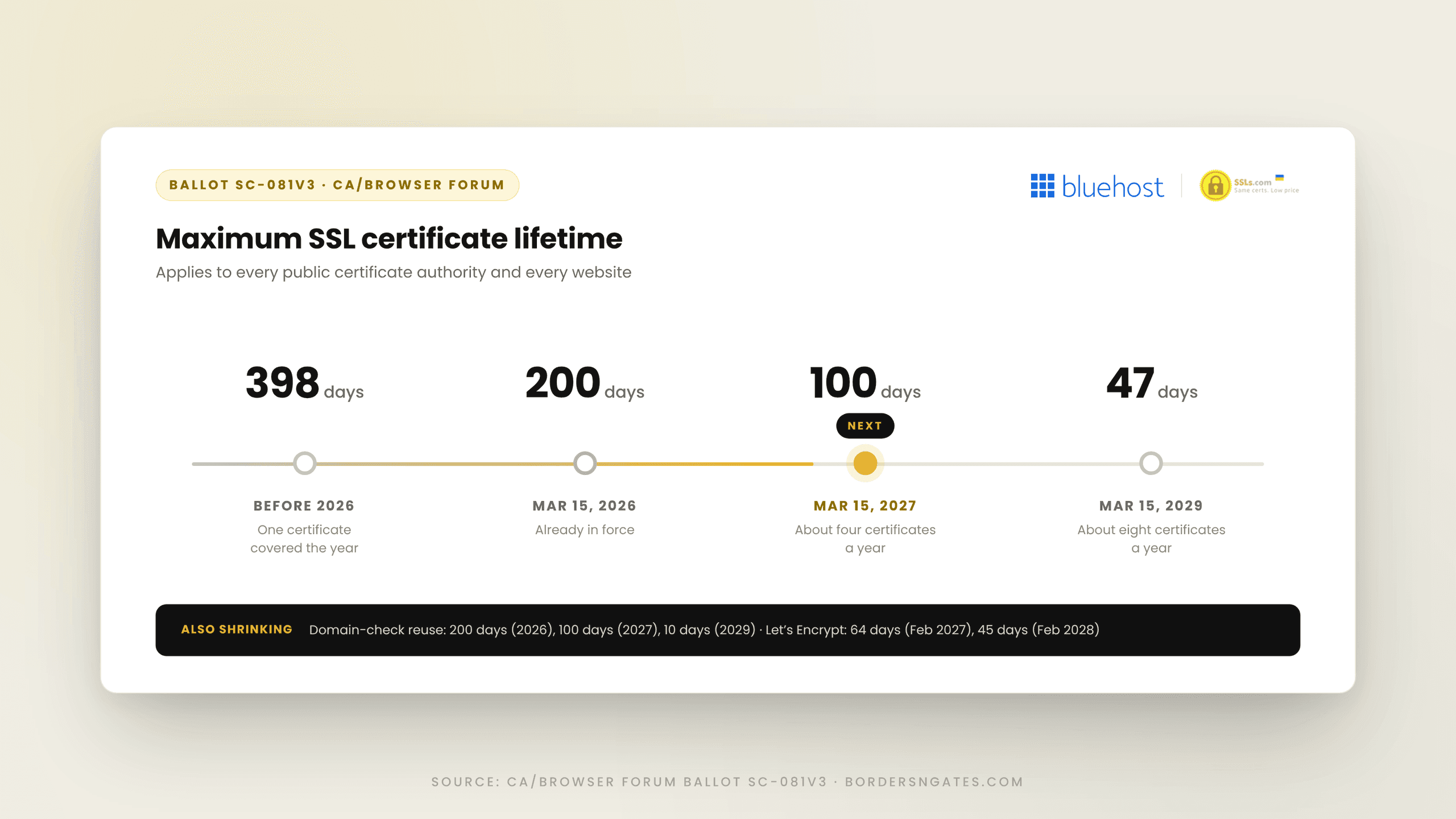
The rule comes from CA/Browser Forum Ballot SC-081v3, approved in April 2025. It applies to every public certificate authority, so it affects every provider and every website, not one brand.
A certificate could cover a little over a year.
The first cut, already in force.
The next cut, and the one this guide prepares for.
The final stage of the current schedule.
Two related changes come with it. The period a provider can reuse a domain check before asking again shrinks on the same dates: 200 days in 2026, 100 days in 2027 and 10 days in 2029. And Let's Encrypt, the free certificate authority behind most hosting-included SSL, is moving its own certificates from 90 days to 64 days in February 2027 and to 45 days in February 2028.
Certificates already issued keep the lifetime they were issued with. The change applies to each new certificate from its effective date.
Why Are Certificates Getting Shorter?
The logic is about limiting exposure. A certificate vouches that a website is who it says it is. If its private key is ever exposed, or the details behind it stop being true, a shorter certificate stops being trusted sooner on its own, without depending on revocation, which browsers do not always check reliably.
Three Reasons Behind the Change
A compromised certificate expires in weeks instead of a year.
Domains change hands; shorter validation reuse means the owner is checked more often.
When security standards move, a short certificate cycle replaces old certificates across the web quickly.
The direction is set. The practical question for a business is not whether to adapt, but how.
What Does It Mean for a Business Website?
The yearly purchase does not disappear. What changes is the certificate inside it. A oneyear SSL subscription now has to be reissued and reinstalled several times within its term and each reissue needs the domain to be validated again.
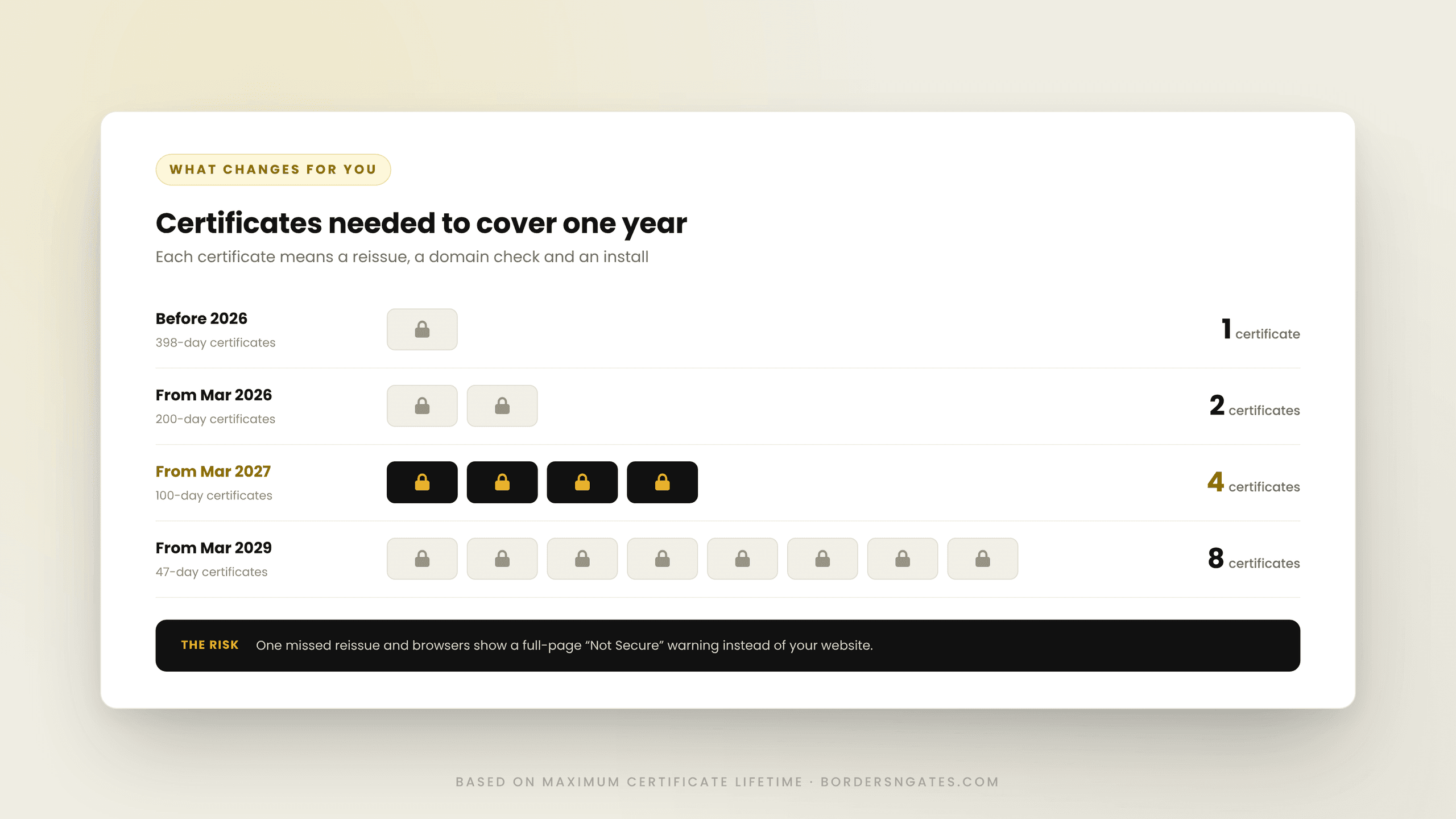
- At 398 days, one certificate covered the year. At 200 days it takes two. From March 2027 it takes about four, and from 2029 about eight.
- With domain-check reuse capped at 100 days, every reissue means proving control of the domain again, by email, file or DNS.
- A missed reissue does not fail quietly. Browsers show a full-page "Not Secure" warning, and visitors, forms and payments stop at that screen.
When Is Bluehost the Right Choice?
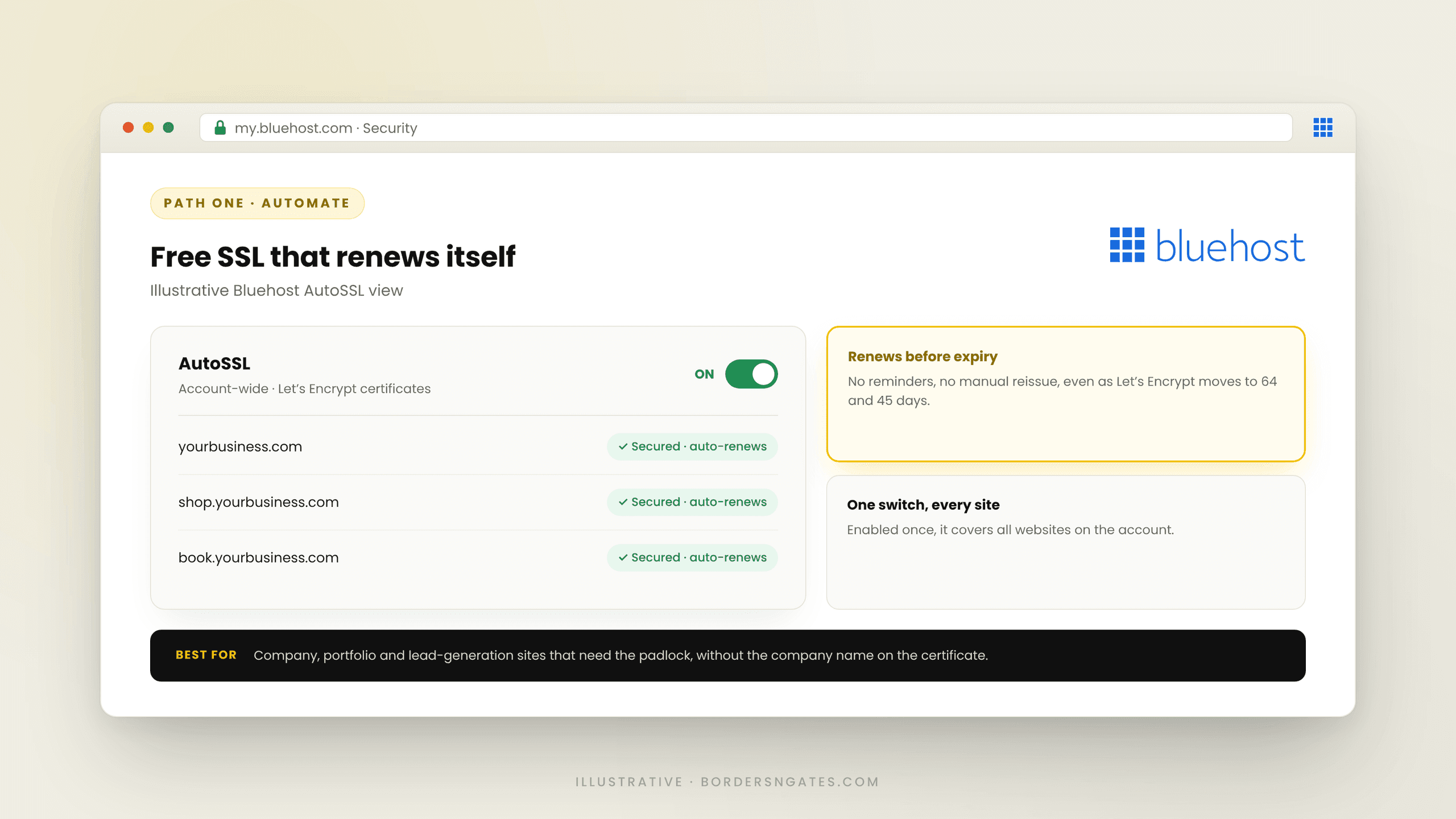
For most business websites, the simplest answer is a certificate that renews itself.Bluehost's free SSL is built for exactly that.
Included on every shared plan.
Installed and renewed automatically.
- Bluehost's Auto SSL uses Let's Encrypt certificates and, in Bluehost's words, "automatically renews your certificates before they expire."
One switch for every site.
- AutoSSL is an account-wide setting, so enabling it once covers all websites on the account.
Shorter lifetimes absorbed for you.
- When Let's Encrypt moves to 64 and then 45 days, the renewal still happens in the background.
This is a Domain Validation certificate: it encrypts the connection and shows the padlock, but it does not name the business behind the site. For a company website, a portfolio or a leadgeneration site, that is usually enough. Turn on AutoSSL in your Bluehost account, then open the site in a browser and confirm the address starts with https://.
When Is SSLs.com the Right Choice?
Some businesses need more than the padlock. Finance, legal, healthcare and enterprisefacing companies are often asked to show a certificate that confirms the registered business behind the site. That is Organization Validation (OV) or Extended Validation (EV), and it is where SSLs.com comes in.
Three Levels of Validation
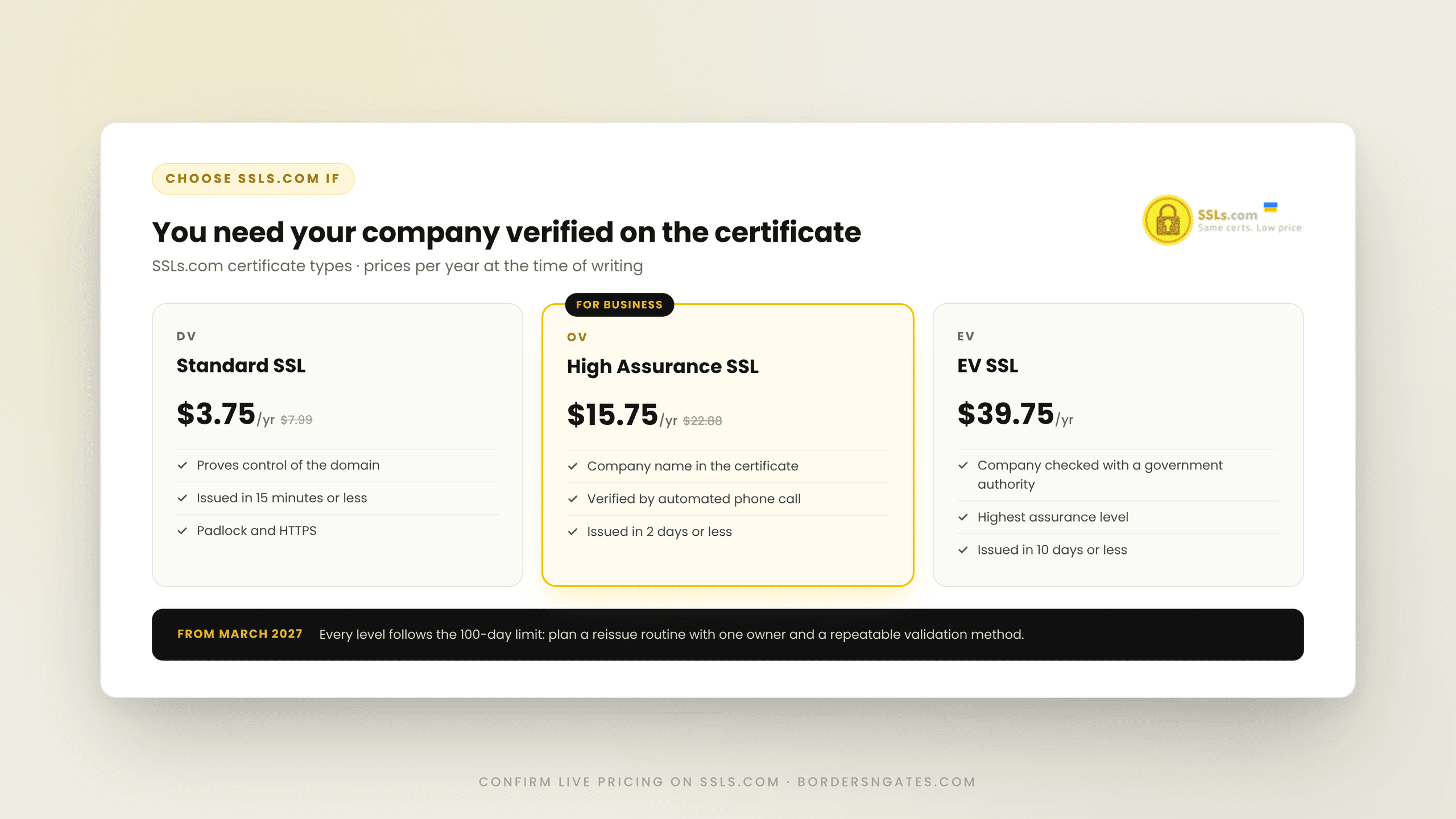
Proves control of the domain. Issued by SSLs.com in 15 minutes or less.
Adds the company name to the certificate; company contact details are verified through an automated phone call. Issued in 2 days or less.
Company existence is checked with a government authority. Issued in 10 days or less.
All three carry the same encryption strength. The difference is how much the certificate proves about who you are. The 100-day rule applies to all of them, so a validated certificate needs a reissue routine of its own:
- Name one owner for certificates, with a backup, so reissues never depend on one inbox.
- Choose a validation method you can repeat quickly, such as a DNS record or a file on the server, before the first reissue is due.
- Set reminders against the certificate, not the subscription. The subscription may run a year; each certificate inside it now runs about 100 days.
SSLs.com keeps the buying side simple: it positions itself on low prices for the same certificate types, with 3-click activation.
What Does It Cost in 2027?
The shorter lifetime does not change what a subscription costs; it changes how often the certificate inside it is reissued. Prices below are list and sale prices at the time of writing, so confirm them on Bluehost's and SSLs.com's own pages before you buy or quote a client.
| Option | Validation | Price per year |
|---|---|---|
| Bluehost free SSL (AutoSSL) | Domain | Included with hosting |
| SSLs.com Standard SSL | Domain | $3.75 (list $7.99) |
| SSLs.com High Assurance SSL | Organization | $15.75 (list $22.88) |
| SSLs.com EV SSL | Extended | $39.75 |
| SSLs.com OV Wildcard SSL | Organization, all subdomains | $112.99 (list $169.99) |
The real cost of the change is not the certificate. It is the hour someone spends on each manual reissue, and the cost of the day a certificate is missed. That is why automation for standard sites and a clear routine for validated ones matter more than the price line.
Your 100-Day Readiness Checklist
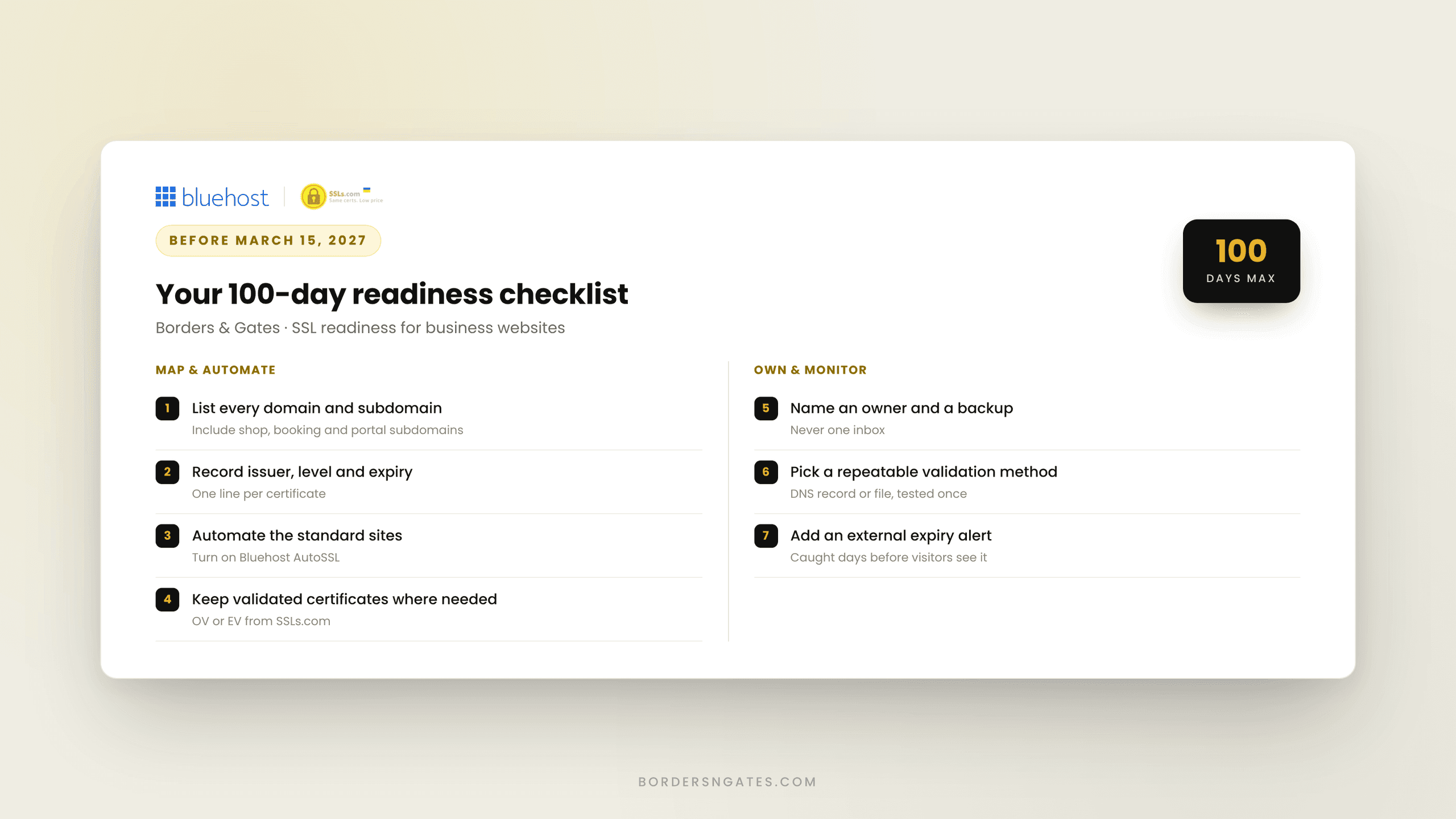
- List every domain and subdomain that serves a certificate, including shop, booking and client-portal subdomains.
- For each one, note who issued the certificate, its validation level and its expiry date.
- Move every site that only needs the padlock to automatic renewal, such as Bluehost AutoSSL.
- Keep business-validated certificates where the company name matters, and set up a reissue routine for each.
- Name a certificate owner and a backup.
- Pick a repeatable validation method (DNS or file) and test it once before March 15, 2027.
- Add an external expiry alert, so a missed reissue is caught days before visitors see a warning.
Frequently Asked Questions (FAQ)
Common questions
Use Bluehost's free SSL if your website only needs the padlock and HTTPS; it renews automatically, which matters more than ever under the 100-day limit. Buy from SSLs.com if your business needs Organization or Extended Validation, which put verified company details on the certificate, or if your site is hosted somewhere without free SSL.
On March 15, 2027. From that date, a new public SSL/TLS certificate can be valid for a maximum of 100 days. The limit has been 200 days since March 15, 2026, and it drops to 47 days on March 15, 2029.
No. A certificate keeps the lifetime it was issued with. The 100-day limit applies to certificates issued from that date onward, so it affects your next reissue or renewal.
Not necessarily. A yearly subscription can still run for a year, but the certificate inside it must be reissued and reinstalled within that term, about four times a year from March 2027. Free certificates from hosts like Bluehost are reissued automatically.
Yes. Bluehost's AutoSSL uses Let's Encrypt certificates and renews them automatically before they expire. It is an account-wide setting, so enabling it once covers every website on the account.
For most company, portfolio and lead-generation websites, yes. Businesses that need to prove the registered company behind the site, often in finance, legal or enterprise sales, should use an Organization or Extended Validation certificate
All three encrypt the connection with the same strength. Domain Validation proves control of the domain. Organization Validation adds verified company details. Extended Validation adds a government-registry check of the company. At SSLs.com they are issued in up to 15 minutes, 2 days and 10 days respectively.
Browsers show a full-page security warning instead of the website. Visitors cannot reach forms, bookings or checkout without clicking past it, and most will leave instead.
From March 2027, an SSL certificate becomes a routine rather than a purchase. For most business websites, the answer is automation: Bluehost installs and renews its free certificate on its own, every time. For businesses that need their identity on the certificate, SSLs.com provides validated certificates at accessible prices, as long as a clear reissue routine sits behind them. If you would rather have this set up and maintained as part of your website, our Web Development team builds, launches and runs business websites with certificate renewal handled from day one.
Subscribe to our newsletter