
Over the past week, the artificial intelligence space has seen a cluster of developments that signal a shift in how the technology is evolving, not just in what it can do, but in how it's built, deployed, and integrated into real environments.
“This is no longer only a race for intelligence. It's increasingly a race for usability, efficiency, and real-world deployment.”
Claude: Reasoning and Context, Not Just Speed
Anthropic's recent Claude updates haven't centered on flashy new features. They've centered on something more foundational: how the model reasons and how much it can hold in a single conversation.
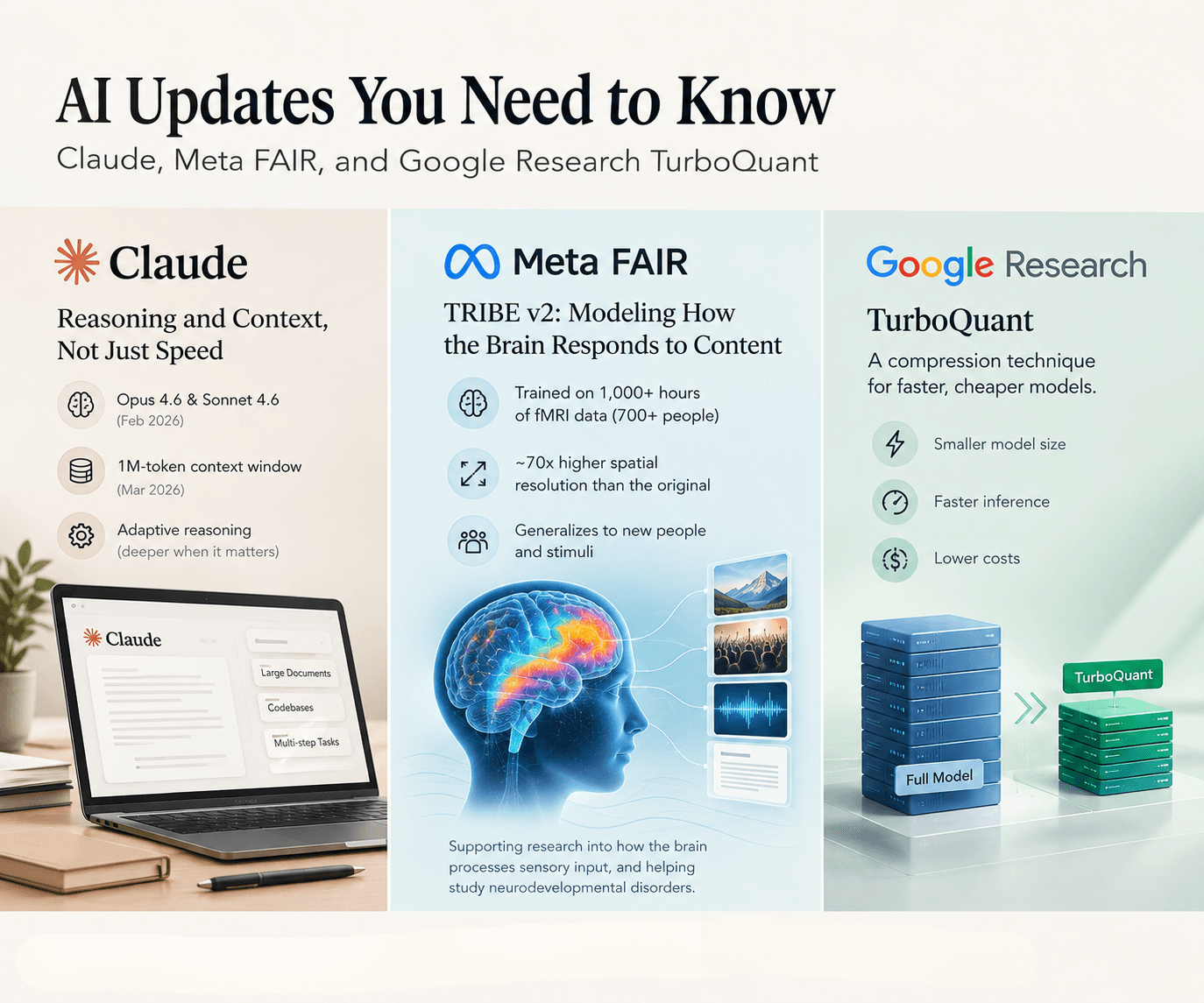
In February 2026, Anthropic released Claude Opus 4.6 and Claude Sonnet 4.6, and in March 2026 made the 1-million-token context window generally available across both models at standard pricing. In practical terms, that means Claude can work through very large documents, codebases, or multi-part tasks in a single session without losing track of earlier details, a meaningful jump from the context limits earlier models worked within.
Alongside the larger context window, Anthropic has also emphasized adaptive reasoning: the model deciding, on its own, when a problem warrants deeper step-by-step thinking versus a fast, direct answer. For users working on detailed tasks, writing, analysis, or strategy, that shows up as answers that feel more structured and less rushed.
The broader pattern is a shift from AI that's purely reactive toward AI that works through a problem before responding. That changes what the tool is for. It stops being just a shortcut to an answer and starts functioning as part of the thinking process itself.
Meta FAIR's TRIBE v2: Modeling How the Brain Responds to Content
Meta's Fundamental AI Research team (Meta FAIR) released TRIBE v2 on March 26, 2026, and it represents a genuinely different research direction from most of the industry.
TRIBE v2 isn't a model for generating text, images, or video. It's a foundation model trained on more than 1,000 hours of fMRI data from over 700 volunteers, built to predict how the human brain responds to images, video, audio, and text. According to Meta, it offers roughly a 70-fold increase in spatial resolution over the original TRIBE model, and can generalize to people and stimuli it wasn't trained on.
Meta's own framing centers on neuroscience
- Accelerating research into how the brain processes sensory input
- Supporting studies of neurodevelopmental disorders
- Helping researchers test hypotheses without needing to scan a new subject for every experiment
That said, the underlying capability, predicting how a brain is likely to respond to a piece of content before a person sees it, has implications that extend beyond the lab. If that kind of prediction becomes broadly usable outside clinical and academic research, it raises real questions about where personalization ends and influence begins. It's worth being clear that this is a plausible extension of the technology, not a use case Meta has stated as a current product application. As of the model's release, adoption outside research settings remains early.
“For the first time, this line of AI research isn't just getting closer to matching human intelligence. It's getting closer to modeling human psychology directly.”
Google Research's TurboQuant: A Shift Toward Efficiency
Google Research published TurboQuant on March 24, 2026, and it points to a different kind of competition than “which model is biggest.”
TurboQuant is a quantization algorithm, specifically, a technique for compressing the key-value cache that large language models use to track context during a conversation. According to Google's published results, it compresses that cache down to roughly 3 bits per value with no measurable loss in accuracy, cutting memory use by at least 6x and speeding up attention computation on NVIDIA H100 GPUs by up to 8x, with no retraining required. It's due to be presented at ICLR 2026.
The practical significance is straightforward: one of the biggest barriers to AI adoption isn't model intelligence, it's infrastructure cost. Long-context, high-quality models are expensive to run at scale because of exactly the kind of memory overhead TurboQuant targets. Techniques like this are what make it more realistic to run capable models on smaller hardware footprints, potentially including edge devices, over time.
It's worth noting that TurboQuant is a research result, not yet a shipped product inside a specific consumer tool. What it signals is a direction: competition increasingly shaped by which systems are efficient and deployable, not only which are most capable in a benchmark.
What These Updates Mean Together
Looked at side by side, a pattern emerges. Each of these efforts is solving a different piece of the same broader shift:
Claude
Improving how AI reasons and handles large amounts of context over a single task.
Meta FAIR
Exploring how AI models human perception and response, a research direction with implications well beyond content generation.
Google Research
Making the underlying infrastructure of AI cheaper and faster to run.
None of this is about experimentation for its own sake anymore. It reflects an industry moving toward practical usability, deeper integration, and operational efficiency; AI shifting from a tool people try to infrastructure people build on.
What Should Businesses Actually Pay Attention To?
For businesses, the specific tools matter less than the direction they point in. AI is becoming easier to access, cheaper to run, and more capable of handling substantial, complex work in a single pass. That combination lowers the barrier to adoption meaningfully.
Companies that once needed significant upfront investment to use AI seriously can now start smaller and scale as needs grow. At the same time, expectations are rising in parallel: customers will increasingly expect fast, accurate, well-reasoned interactions as the baseline, not a differentiator.
- Not whether to adopt AI, but how to adopt it in a way that produces real operational value rather than novelty.
Frequently Asked Questions
Common questions about these updates
TurboQuant is a quantization algorithm from Google Research that compresses the key-value (KV) cache large language models use to track context, cutting memory use by at least 6x with no measurable loss in accuracy. It was published on March 24, 2026, and is due to be presented at ICLR 2026.
No. According to Google's published results, TurboQuant compresses the KV cache to roughly 3 bits per value and speeds up attention computation on NVIDIA H100 GPUs by up to 8x with no retraining required.
Not yet as a product. TurboQuant is a research result and has not been shipped inside a specific consumer tool.
TRIBE v2 is a foundation model from Meta FAIR, released on March 26, 2026, that predicts how the human brain responds to images, video, audio, and text. It was trained on more than 1,000 hours of fMRI data from over 700 volunteers and offers roughly 70 times the spatial resolution of the original TRIBE model.
The relevant question is not whether to adopt AI but how to adopt it in a way that produces real operational value rather than novelty. AI is becoming easier to access, cheaper to run, and more capable of handling complex work in a single pass, which lowers the barrier to adoption.
What's happening right now isn't a single announcement. It's a shift in how AI fits into real workflows, driven by better reasoning, deeper research into human response, and infrastructure that makes deployment more practical.
The organizations that benefit most from this phase won't necessarily be the ones who move first. They'll be the ones who understand where the shift is heading and build toward it deliberately. Because at this stage of AI's development, execution matters more than experimentation.
Subscribe to our newsletter