
The buyers are ready. The price is right. The distributor is signed. And the shipment can still be refused at the point of entry, because of the box it arrives in. Since August 2026, that is the risk hiding in many European expansion plans.
“That is the real story of the EU's new packaging regulation. It is not a packaging story. It is a market access story.”
What Changed on 12 August 2026: The PPWR Explained
Most companies build their European expansion plans the same way: find demand, price competitively, secure a distributor, ship. That plan now has a gap in it. A product can have willing buyers in Germany or France and still be refused, not because of what is inside the box, but because of the box itself and the paperwork behind it.
The EU Packaging and Packaging Waste Regulation (Regulation (EU) 2025/40, or PPWR) applies generally from 12 August 2026. It replaces a directive dating from 1994, applies directly in all 27 Member States, and covers all packaging placed on the EU market regardless of material or origin.
Which PPWR obligations apply now?
- Substance limits. Limits on lead, cadmium, mercury and hexavalent chromium, plus new PFAS limits for food contact packaging. Stock produced earlier but placed on the market for the first time after 12 August must already comply.
- Conformity and documentation. A conformity assessment, technical documentation and a declaration of conformity before packaging is placed on the market.
- Identification. The producer's name or trade mark, a postal address, and a type, batch or serial number on the packaging.
- Producer responsibility. Registration and scheme obligations continue and expand at national level, with country specific registers and deadlines.
A phased regulation, not a single switch
Substance limits (lead, cadmium, mercury, PFAS), conformity assessment and documentation, producer identification on packaging, registration and scheme obligations.
Recyclability grading requirements and design-for-recycling criteria.
Harmonised labelling, mandatory recycled content, and packaging minimisation rules.
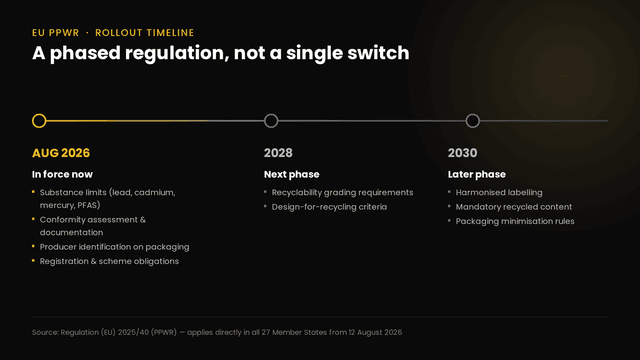
The commercial point is simple: if your packaging does not meet the applicable requirements, it cannot legally be placed on the EU market, wherever your company is based.
Why the EU Packaging Regulation Is a Market Access Issue, Not a Compliance Detail
Most market entry analysis stops at four questions: Is there demand? Can we compete on price? Who are the incumbents? How do we distribute? Those questions decide whether a market is attractive. They do not decide whether you are allowed in.
Regulation is the fifth question, and it behaves differently. Demand can be built over time, pricing adjusted, distribution renegotiated. A missing declaration of conformity, or a supplier who cannot certify what is in a laminate, stops the shipment on the day it matters.
- Your EU importer or distributor carries legal responsibility for what they place on the market and will ask you for documentation, substance data and traceability.
- If you cannot provide it quickly and credibly, you are no longer a supplier, you are a risk on their books.
- The competitor who can produce the file wins the shelf.
What Exporters Should Reconsider Before Entering the EU Market
Six areas deserve a second look in any EU expansion plan:
Six areas to reconsider
For EU purposes, the pack is regulated in its own right. Design, materials and inks are specification items with legal weight, not a cost line at the end of the process.
The conformity file depends on data from converters and material suppliers, many of whom have never been asked for PFAS or heavy metal declarations. Finding out who can answer, and who cannot, is the first job.
Each packaging type needs its own file, kept current as materials or suppliers change. This is a process to own, not a form to sign.
Testing, redesign, supplier changes and registration fees land before the first sale. Landed cost models that ignore them overstate margin.
Redesign, supplier qualification and documentation take months. A plan that puts compliance after the distributor agreement discovers the barrier after the investment.
Whether you are treated as producer, importer or distributor in a given Member State changes what you must do. Settle it per market, early.
The Bigger Lesson: Proof of Compliance Is Becoming a Condition of Access
Packaging is one example of a wider pattern. Deforestation rules, carbon border adjustments, product safety regimes and digital product passports all point the same way: proof of compliance is becoming a condition of access to the world's largest single market.
Companies that treat regulatory readiness as a final check will keep meeting the same wall, in different forms, in every market they enter. Companies that treat it as part of the opportunity assessment move faster, quote with confidence, and hold onto European customers when the next phase of rules arrives.
“International expansion has always required commercial opportunity and operational readiness together. Europe has simply made the second half visible.”
Five Questions to Answer Before You Commit to the EU
A readiness check drawn directly from this briefing:
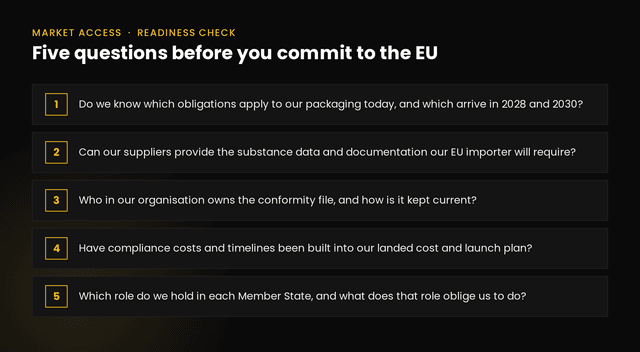
The readiness check
Do we know which obligations apply to our packaging today, and which arrive in 2028 and 2030?
Can our suppliers provide the substance data and documentation our EU importer will require?
Who in our organisation owns the conformity file, and how is it kept current?
Have compliance costs and timelines been built into our landed cost and launch plan?
Which role do we hold in each Member State, and what does that role oblige us to do?
The companies that expand well do not avoid regulation. They see it early, cost it accurately and build it into the entry roadmap alongside demand, pricing and distribution. Assessing market access requirements and entry readiness before resources are committed is where that discipline begins, and where a strategic partner adds the most value.
Subscribe to our newsletter